Security
Security, AI Act and GDPR
Claude works in your company’s software with the permissions we agree for each program. This page describes how we set up access, where data goes and what the AI Act and the GDPR ask of your company and of us.
01 · Permissions
Permissions set program by program
Before we connect a program, we agree with you what Claude can read, what it can change and at which steps your approval is needed. The permissions for each program are limited to what the agreed tasks require.
- Approval at sensitive steps
- When an operation has effects outside the company, such as a reply to a customer, Claude prepares a draft and the operation goes ahead once you approve it in the app.
- Revocable access
- Claude’s access can be revoked program by program. If you stop the service we revoke all of it, and your data stays in your company’s software and accounts.
| Program | Access | Agreed scope |
|---|---|---|
| Management system | read and write | Reads orders and customer records; enters supplier invoices already checked |
| draft | Drafts replies to customers; you approve sending | |
| Shared documents | read | Only the price list and product sheet folder |
| Online store | read | Orders and shipping status |
| Bank accounts | none | Outside the project |
02 · Data processing
Where data stays and who handles it
Connecting Claude does not move your company’s records: the data stays where it is and is read when a task requires it.
- In your software
- Operational data stays in your management system, email and archives. Claude accesses it within the permissions agreed for each program.
- In the app
- In Plico you find what concerns the project: questions and answers, shared files, the status of your automations and the reports.
- At Anthropic
- The automations use Claude through Anthropic accounts that we open and maintain for your company alone. Anthropic’s Commercial Terms (opens in a new tab) rule out training models on content received through these services, and for the API its privacy documentation (opens in a new tab) provides for deleting inputs and outputs within 30 days, with the exceptions it lists.
- In Europe, when needed
- For projects that handle sensitive data we configure the AI so that processing stays in European regions, for example with Amazon Bedrock.
The details are in the privacy policy and the terms of service (in Italian).
03 · AI Act and GDPR
The obligations that apply to your company
The AI Act, Regulation (EU) 2024/1689, governs the use of artificial intelligence systems; the GDPR, Regulation (EU) 2016/679, governs the processing of personal data. For each project we check which obligations apply to the work we hand to Claude.
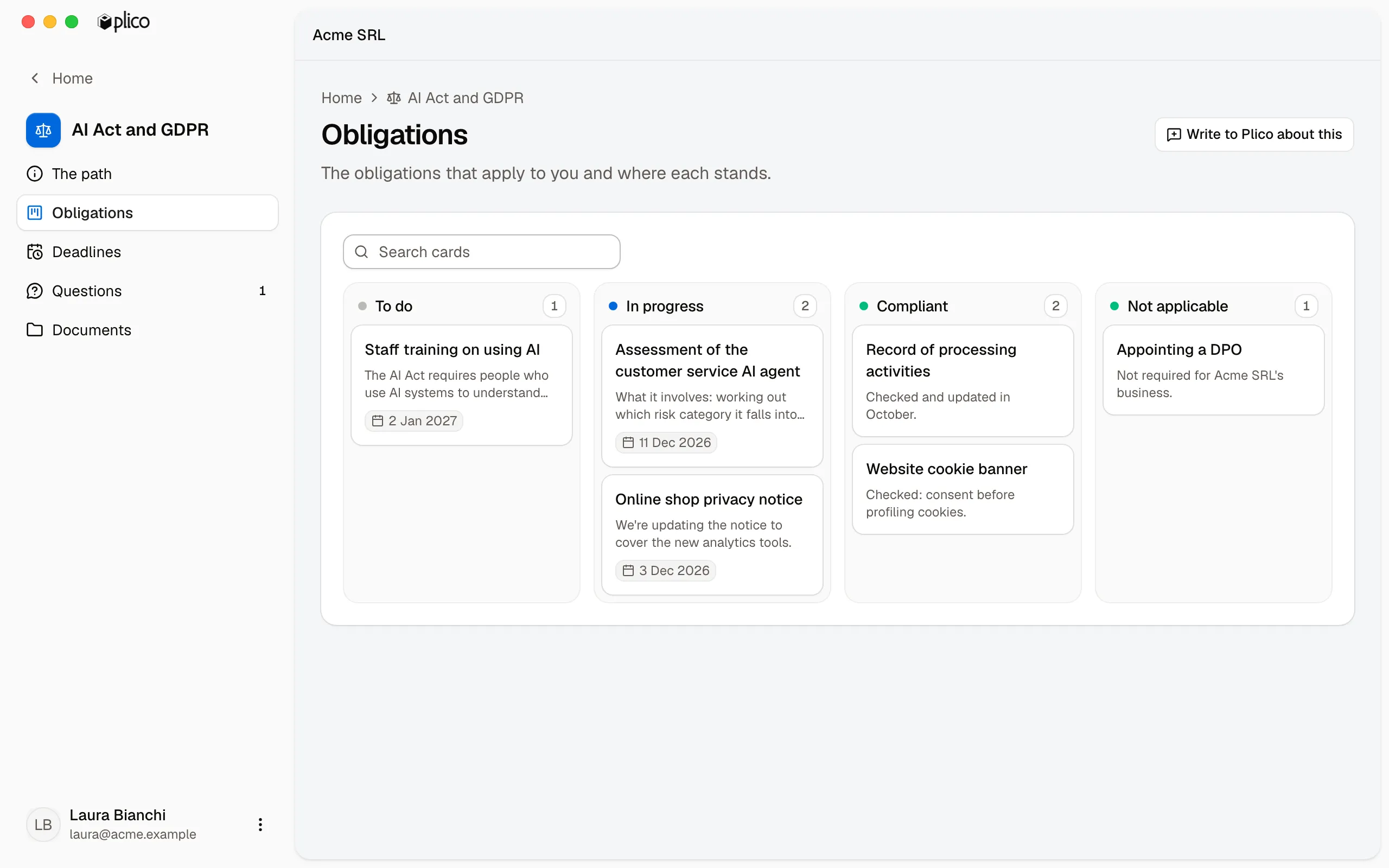
In the AI Act and GDPR module of the app you find the obligations that apply to your company, split into to do, in progress, compliant and not applicable, with the deadlines and the current version of each document.
- AI Act, Art. 50
Transparency toward the people writing in
What the law requiresFrom August 2, 2026, people who interact with an AI system must be informed that they are interacting with AI.
What we doThe AI agents that answer your customers, on WhatsApp or by email, say so in their first message.
- AI Act, Annex III
High-risk uses
What the law requiresSome uses, such as screening job candidates or assessing the creditworthiness of individuals, are classified as high-risk and bring obligations for the company using them too, including human oversight and informing the workers concerned in advance. Under the postponement that took effect on July 27, 2026, these obligations apply from December 2, 2027.
What we doDuring the analysis we check whether a task falls into these categories and, before designing it, tell you what that involves.
- GDPR, Art. 28
Data processing agreement
What the law requiresWhen a provider processes personal data on the company’s behalf, the relationship is governed by a contract that sets out the subject matter, duration, nature and purpose of the processing, the type of data and the categories of data subjects. The provider does not engage other processors without the controller’s written authorization.
What we doWe act as a processor under this agreement. The current list of model and infrastructure providers acting as sub-processors is available on request.
- GDPR, Art. 30
Record of processing
What the law requiresThe record describes the personal data processing carried out by the company; it is kept in writing, including in electronic form, and must be made available to the supervisory authority on request.
What we doFor each automation that processes personal data, we tell you what to enter in the record.
This section summarizes the rules for information only and is not legal advice. Official texts on EUR-Lex: AI Act (opens in a new tab), Regulation (EU) 2026/1744 (opens in a new tab), GDPR (opens in a new tab).
Book a call
In a 30-minute call we assess with you where AI can work in the software your company already uses.